A palace built for one summer, kept for good
The Petit Palais was built for the 1900 Exposition Universelle, the World's Fair that drew tens of millions of visitors to Paris. Unlike most fair pavilions, it was never torn down.
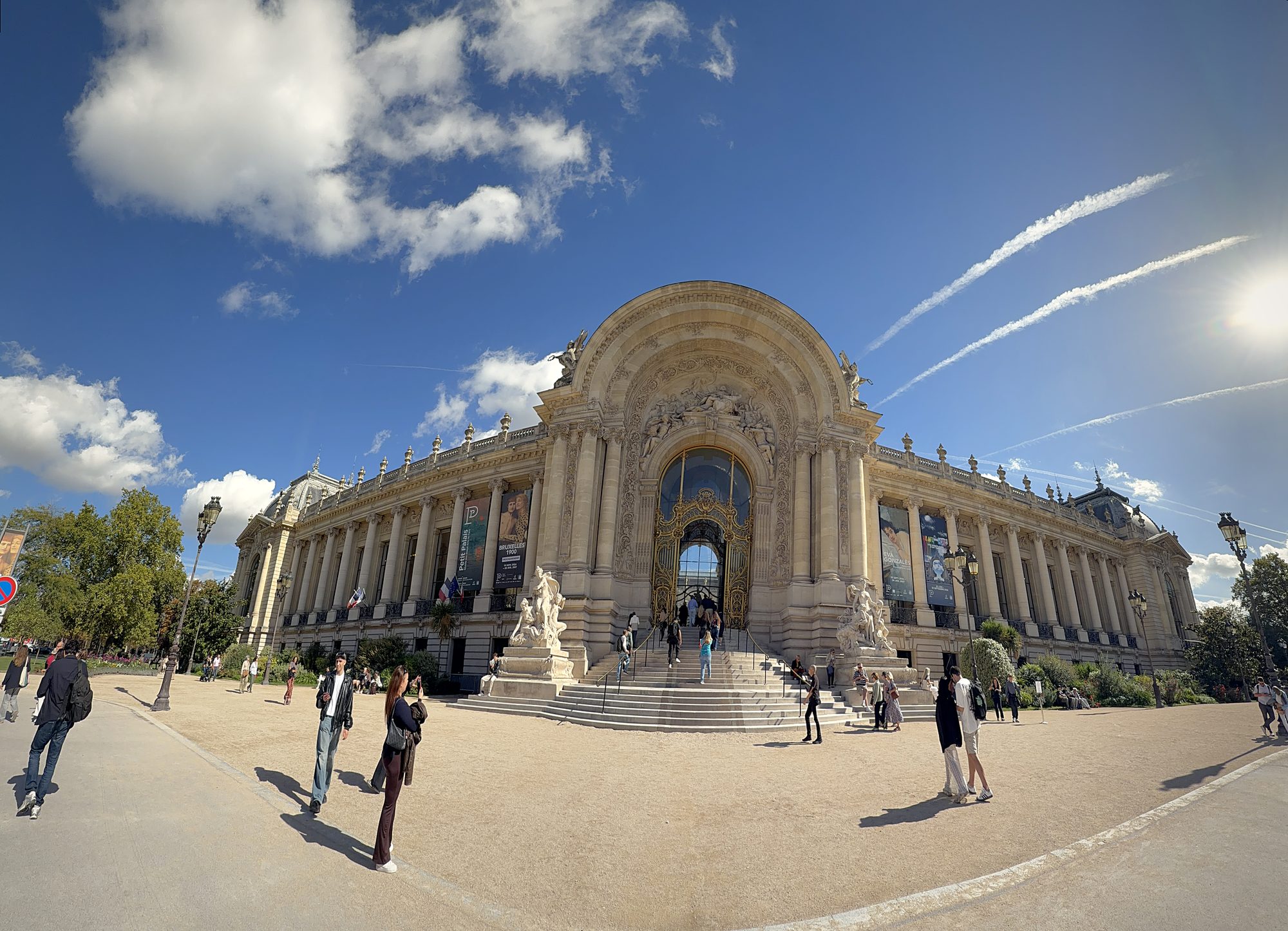
The architect Charles Girault designed it as a showpiece of the Beaux-Arts style: a trapezoid of galleries wrapped around a semicircular garden, fronted by a monumental arched entrance, a sculpted dome and a gilded wrought-iron gate. Its twin across the avenue, the Grand Palais, went up at the same time, and together they frame the view from the Champs-Élysées to the Pont Alexandre III and the Invalides.
In 1902 the City of Paris turned the building into its fine arts museum. The collections grew quickly through gifts, most famously the bequest of the brothers Auguste and Eugène Dutuit, which brought antiquities, Renaissance objects, clocks, drawings and Old Master paintings.
Today the museum covers art from the ancient Mediterranean to around 1900: Greek vases, Renaissance enamels and majolica, Dutch and Flemish painting, French 18th-century art, and a deep collection of 19th-century painting and sculpture, from Ingres and Courbet to the Impressionists, the Symbolists and Art Nouveau. A major renovation, completed in 2005, restored the painted ceilings, mosaics and natural light.
The building is as much the attraction as the art. Look up in the entrance rotunda, take the spiral staircase, and leave time for the garden café in the courtyard.
- Opened
- 1900
- Architect
- Charles Girault
- City museum since
- 1902
- Address
- Avenue Winston-Churchill, 75008
The Palace
10 photographs
The façade on Avenue Winston-Churchill
Charles Girault, 1900
Built for the 1900 Exposition Universelle, the palace greets you with a monumental arched entrance, a gilded wrought-iron gate and a sculpted dome.
The colonnade
Charles Girault, 1900
Ionic columns run the length of the front, a deliberate echo of the classical architecture Paris loved at the turn of the century.
Sculpture at the entrance steps
Petit Palais
Allegorical figures flank the main stair, part of the decorative programme that turns the building itself into a work of art.
The painted entrance rotunda
Petit Palais
Painted cupolas, marble floors and tall arched windows set the tone the moment you step inside.
The great spiral staircase
Charles Girault
One of the most photographed details in the building: a sweeping double-curved stair with Art Nouveau ironwork.
Ironwork and light
Charles Girault
Seen from below, the balustrade's iron tendrils curl around a skylit opening.
The skylit galleries
Petit Palais
Long galleries with overhead daylight were designed to show large paintings the way artists intended.
The sculpture hall
Petit Palais
Plaster, marble and bronze figures stand under the glass roof of the long gallery.
The red gallery
Petit Palais
Deep red walls frame the museum's largest 19th-century canvases.
A salon-style hang
Petit Palais
Large narrative paintings hung close together, the way they were shown at the Paris Salon.
The Galleries
16 photographs
The blue gallery
Old Masters
Deep blue walls set off gilded frames in the rooms devoted to 17th-century painting.
Into the landscape rooms
Old Masters
A ceramic tower stands at the threshold of the green landscape galleries.
Golden-age landscapes
17th–18th century
Classical landscapes hang on muted green walls, lit like windows onto Italy and Holland.
Dutch landscapes and seascapes
17th century
Wide skies, windmills and ships in a small, quiet room.
The Dutch cabinet
17th century
Small-format genre scenes and portraits, made for collectors' homes rather than churches.
Portraits and interiors
17th century
Domestic interiors and sober portraits from the Dutch Golden Age.
The still-life gallery
17th century
Laid tables, game and flowers line the walls around a marble figure.
Birds, flowers and game
17th–18th century
A peacock in full display anchors this wall of decorative animal painting.
The Troubadour room
Early 19th century
Purple walls and a Gothic-revival chair introduce the romantic taste for the Middle Ages.
Purple galleries
19th century
Marble, porcelain and gilt bronze sit together in the 19th-century rooms.
The Pre-Raphaelite room
Late 19th century
Works by Burne-Jones and his circle, with Renaissance-style tabernacle frames.
The Impressionist room
Late 19th century
Monet, Sisley and their contemporaries around a reconstructed outdoor painting kit.
Vuillard's decorative panels
Édouard Vuillard
Four tall panels of figures in interiors, designed as wall decoration for a Paris apartment.
The Renaissance gallery
Lower level
Under stone arches: majolica, enamels, bronzes and carved reliefs.
The antiquities gallery
Lower level
Greek and Roman objects in glass cases along a vaulted corridor.
A sculpture gallery
19th century
Busts and small bronzes spaced out in a pale, daylit room.
Paintings
33 photographs
The Virgin adoring the Child, with the young Saint John
Workshop of Sandro Botticelli, Florence, late 15th century
A round devotional panel (tondo) in a carved and gilded fruit-garland frame.
Tondo and wedding chest
Italian Renaissance
The same tondo hangs above a carved walnut cassone and a twisted vine column.
Virgin and Child enthroned, crowned by angels
Italian school, 15th century
Saints and music-making angels surround the throne, in an architectural gilt frame.
Virgin and Child before a landscape
Venetian school, c. 1500
The Child reaches toward his mother against open sky, in a richly painted frame.
The Meal of Diana
Jacob Jordaens
A Flemish feast of nymphs, satyrs and hunting trophies under a red canopy.
Pair of mythological scenes
French school, 17th century
Two large canvases of Diana and her nymphs bathing, hung as companions.
Sunset
Claude Gellée, called Claude Lorrain
Travellers ride toward a harbour bathed in golden evening light, in an octagonal mount.
Landscape
Francisque Millet
An idealised classical landscape with figures on a sunlit path.
The Rape of Proserpine
Peter Paul Rubens
A rapid oil sketch: Pluto seizes Proserpine as Minerva and Diana try to intervene.
Saint Peter's Square at the election of Pope Clement VIII
Louis de Caullery, c. 1600
Crowds fill the square in front of the old façade of Saint Peter's, before Bernini's colonnade existed.
Democritus
Jusepe de Ribera
The laughing philosopher, shown as a real man of the street holding a sheet of writing.
Head of Saint Frances of Rome
Orazio Gentileschi, c. 1618
A study of extraordinary tenderness: a white veil painted with blue reflections.
Red partridge in a niche
Nicolas de Largillierre
Game, grapes, peaches and a split pomegranate on a stone ledge.
Still lifes
Dutch and Flemish, 17th century
Laid tables and a fruit-and-flower piece by Isaac Soreau.
Flock in a storm
Georges Michel
A shepherd hurries his flock along a ridge as a dark sky breaks over the plain.
Francis I receives the last breath of Leonardo da Vinci
Jean-Auguste-Dominique Ingres
The French king cradles the dying Leonardo, a romantic episode of art history.
Henri IV playing with his children
Jean-Auguste-Dominique Ingres, 1817
The king on all fours with his children as the Spanish ambassador walks in.
The sick nun
François-Marius Granet, c. 1830
A quiet convent interior with deep perspective, inspired by Dutch painting.
Light effect in the ruins
Attributed to François-Marius Granet
Vaulted ruins open onto a bright Roman countryside.
Italian landscape with three knights
Pierre-Athanase Chauvin, 1806
Knights in armour ford a stream beneath umbrella pines near Frascati.
A medieval scene in a Gothic interior
French Troubadour style
History painting staged inside a Gothic church.
In the painter's studio
French Troubadour style
A young woman kisses a painter at his easel, in Renaissance costume.
The Departure of the Prodigal Son
James Tissot
The story set in Renaissance Venice, with ships waiting on the lagoon.
The Return of the Prodigal Son
James Tissot
The companion piece: the son kneels in the street as his father reaches out.
Cornish cliffs
John William Inchbold
Turquoise sea and flowering rocks, painted with Pre-Raphaelite precision.
Lamia
John William Waterhouse
The enchantress by a pool, her snakeskin draped around her.
Soir antique
Alphonse Osbert
Muses with lyres watch the sun set over a calm sea, in the blue light of Symbolism.
Bal blanc
Joseph-Marius Avy
Young women dance to a piano at a white ball, a swirl of silk and light.
Le Pont Royal and the Pavillon de Flore
Camille Pissarro, 1903
The Seine and the Louvre in spring light, painted in the year of his death.
Idyll
Jean-Jacques Henner
Two nymphs by a pool at dusk, their pale skin glowing against dark woods.
A 19th-century history painting
French school
A dramatic figure group in a large Salon canvas.
Two portraits
Henri Pille; Albert Besnard
A seated artist in his studio, and Besnard's portrait presumed to show Marcel Bing.
The red armchair, and a Japanese-style screen
Late 19th century
Painting and furniture shown together in the Japonisme room.
Sculpture
30 photographs
Gloria Victis
Antonin Mercié
Under a stained-glass oculus, a winged Glory lifts a fallen soldier: a monument to the defeated of 1870.
Gloria Victis, seen from below
Antonin Mercié
Bronze wings against the marble walls of the dome.
L'Emprise
Pierre-Félix Fix-Masseau, 1894–1900
A crouching woman tries in vain to push away five grimacing masks, perhaps the deadly sins.
Young woman with an iris
Terracotta
Backlit by the window grille, she studies a single flower.
A martyr bound to a tree
Terracotta model
A tense Baroque composition: a bound youth and a soldier in plumed helmet.
Allegorical figure with a mirror
Marble
Finely pleated drapery and a winged head at her chest.
Venus and Bacchus
Gilt bronze
A pair of statuettes on Rococo pedestals with portrait medallions.
Woman in a patterned gown
Polychrome sculpture, c. 1900
A painted figure in an embroidered dress, with a small animal at her feet.
A recumbent tomb figure
19th century
A shrouded body on a carved sarcophagus.
Crowned figure
Plaster model
A study for a monumental statue.
Marble group
19th century
Two figures in an intertwined pose.
Figure raising a torch
Sculpture hall
A woman lifts a cup of fire toward the window.
Embracing figures
Plaster
Two figures locked together in a dramatic embrace.
Man carrying a body
Plaster
Muscular figures framed by the arched windows.
A winged struggle
Plaster
A dramatic group set against the trees of the gardens outside.
Dancing figure
Plaster
A figure caught mid-turn, arms raised.
Mother and child
Marble
A tender group in front of a painted canvas.
Portrait statue
Plaster
A bearded man, hand at his chin.
Man shielding his eyes
Plaster
A worker scanning the horizon.
Bronze dancer
Bronze
A figure balanced on one foot against the blue Paris sky.
Allegorical group with a flag
Bronze
A standard-bearer and soldiers, typical of post-1870 monuments.
Woman with a child
Plaster
A mother walks forward carrying her child.
Marble lady
Marble
A tall figure under the gallery's painted ceiling.
Winged group
Bronze
A small bronze of figures sheltered by great wings.
Pensive woman
Terracotta
A seated figure lost in thought.
Lioness
Marble
A great cat stalking along its plinth.
Lady in red marble
Polychrome marble
White marble flesh against draped red stone.
Nymphs of the Fontaine des Innocents
After Jean Goujon, 16th century
Five long reliefs of water nymphs in clinging drapery, masterpieces of the French Renaissance.
Figure of roots
Contemporary
A body made of branching roots, spreading across its plinth.
Fragments
Contemporary installation
Black casts of a face, hands and feet around a wrapped form.
Decorative Arts
17 photographs
Clocks and watches of the 16th–17th centuries
Dutuit bequest
Tower clocks, crucifix clocks and cross-shaped watches in rock crystal.
Precious horology
Dutuit bequest
A domed table clock, an astronomical tower clock and a jewelled travel watch.
Empire mantel clock
Gilt bronze and marble, early 19th century
Two classical figures recline either side of the dial.
Glazed earthenware
Followers of Bernard Palissy, Fontainebleau workshops
Moulded dishes and figures in rich lead glazes.
Rouen faience
18th century
A platter with the arms of the duc de Saint-Simon, and helmet-shaped ewers.
Ceramic tower with a bird
Glazed earthenware
A tall vessel crowned by a preening bird.
Gothic-revival chair
19th century
Gilded unicorns support a crowned shield under the motto nihil obstat.
Medici-shaped vase
Porcelain and gilt bronze, early 19th century
A painted scene on a deep blue ground with ram's-head handles.
Blanc de Chine figures and powder-blue cisterns
China, 17th–18th century; French mounts
Laughing Taoist immortals above two cisterns in French gilt-bronze mounts.
Pair of painted vases
19th century
Flowers on a dark ground, with chimera handles, beneath a small landscape.
A landscape painter at work
Alexandre Nozal; Henri Harpignies
Open sketchbooks and a framed watercolour.
Art Nouveau dining room
Hector Guimard
Carved walnut panelling that flows like plant stems, by the designer of the Paris Métro entrances.
Vases
Hector Guimard and Edmond Lachenal, c. 1898
Glass and glazed stoneware in watery blues and greens.
Japanese-style display cabinet
Late 19th century
A pagoda roof, dragons and cranes in gilt bronze.
The Service Rousseau
Félix Bracquemond for Eugène Rousseau
Plates with birds, fish and flowers copied from Japanese prints.
An Impressionist's outdoor kit
Late 19th century
Parasol, easel, folding stool and paint box: everything needed to paint outside.
Inside the paint box
Late 19th century
Original tubes and brushes, still stained with colour.
Antiquities
12 photographs
Greek bronzes
Antiquity
Small bronzes, an animal figure and a sword in a glass case.
Greek vases
Antiquity
Red- and black-figure pottery in the lower galleries.
Attic vases
Ancient Greece
Amphorae and drinking cups.
Red-figure amphora
Ancient Greece
Figures painted in reserve against a black glaze.
Red-figure krater
Ancient Greece
A wine-mixing bowl decorated with a procession.
Vase against the window
Ancient Greece
Backlit by the ironwork of the garden windows.
Large decorated jar
Antiquity
Moulded faces and figures around a broad body.
Terracotta figurines
Antiquity
Draped women and small statuettes.
Votive statuettes
Antiquity
Standing figures displayed on a dark plinth.
Marble head
Antiquity
A curly-haired head on a stone pillar.
Bronze athlete
Antiquity
A striding figure in dark patinated bronze.
Bronze candelabrum
Antiquity
A stand on lion's feet, topped by a small figure.
Our Visit
6 photographs
On the steps
Petit Palais, Paris
Arriving under the golden gate.
In front of the palace
Petit Palais, Paris
Blue sky over the dome.
At the entrance
Petit Palais, Paris
Lace and limestone.
On the spiral staircase
Petit Palais, Paris
Light from the windows on Girault's ironwork.
Descending the staircase
Petit Palais, Paris
The staircase at its most cinematic.
Looking closely
Before Jordaens' Meal of Diana
A moment in the blue gallery.
Visit
Permanent collections are free. Check opening hours and current exhibitions on the official site before you go.
Photographs by Roman Kovalchuk, taken on a personal visit. This site is not affiliated with the Petit Palais or the City of Paris.